
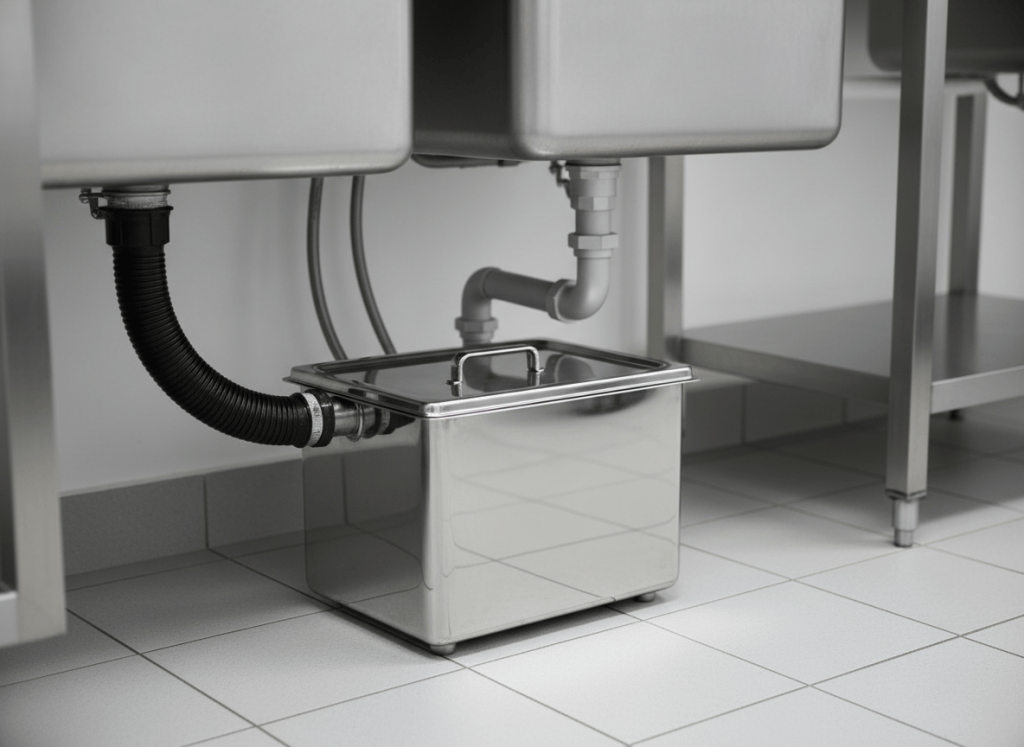
Short answer: it depends on your city. Most programs set a maximum interval, and many add the 25% rule: pump once grease and food solids fill a quarter of the trap. In the six cities we cover, indoor traps need cleaning weekly to monthly, and outdoor interceptors every 90 days to six months.
Below are the published rules in the six cities we cover, how the 25% rule works, and how to set a schedule that keeps you ahead of inspections.
Grease trap cleaning rules in 6 cities
Every city sets its own rules, and they differ more than most people expect. Here’s what each city’s published program says.
| City | Small / indoor traps | Large / outdoor interceptors | Records to keep |
|---|---|---|---|
| Knoxville, TN | At least monthly unless KUB approves otherwise in writing; weekly solids checks; a violation at 25% grease + solids | Logs and manifests for the previous 12 months | |
| Chattanooga, TN | At least weekly (30 days may be allowed if professionally cleaned) | At least every 3 months, or sooner at 25% of liquid depth | 3 years |
| Lubbock, TX | Not covered by the city page we use | At least every 90 days | Trip tickets for 3 years |
| Corpus Christi, TX | Every 90 days or at 25% of depth, whichever comes first; city-permitted haulers only | Manifests for 5 years | |
| Amarillo, TX | No fixed interval; service “on a regular basis” and within 10 business days if an inspector flags it | Most recent manifest on site | |
| Lexington, KY | At least weekly, or as your permit requires | At least every 6 months, or as your permit requires | Not stated in the source we use |
Two patterns stand out. First, fixed intervals for outdoor interceptors range from 90 days to six months, so a schedule that’s legal in one city can be a violation in another. Second, three of the six programs (Knoxville, Chattanooga and Corpus Christi) add a 25% trigger, which can require service before the calendar deadline.
What is the 25% rule for grease traps?
The 25% rule says a grease trap or interceptor must be pumped once the floating grease layer and the settled solids layer together take up 25% or more of the trap. Programs measure this slightly differently: Knoxville refers to the trap’s capacity, Chattanooga and Corpus Christi to its depth. The idea is that a trap past this point has less room left to separate grease, so more can pass into the sewer.
A worked example from the Sioux City Wastewater Treatment Plant shows the math:
- Floating grease layer: 0.5 ft
- Settled solids layer: 1.0 ft
- Total depth of contents: 4.0 ft
- (0.5 + 1.0) ÷ 4.0 = 37.5%, which is over the limit, so this kitchen needs to pump more often.
In practice, ask your service provider to measure and record both layers at every visit. Chattanooga’s program, for example, lists measured grease and solids depths among the records kitchens must keep.
Why do indoor grease traps need cleaning more often?
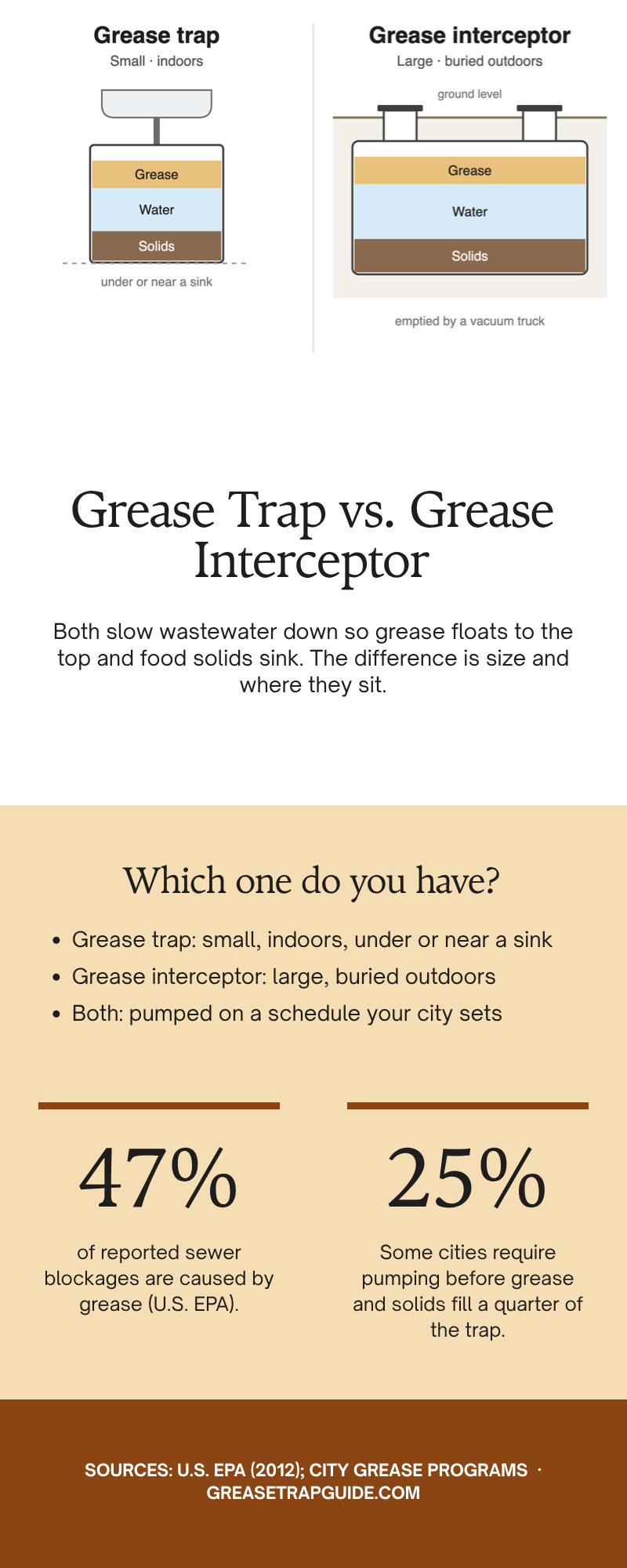
Size. An indoor grease trap is a small unit under or near a sink, so it reaches the 25% mark quickly. An outdoor grease interceptor is a large tank, often holding hundreds or thousands of gallons, so it takes much longer to fill. That’s why Chattanooga and Lexington require weekly cleaning for indoor traps but allow months between interceptor pump-outs.
What if my city has no fixed schedule?
Some programs, like Amarillo’s, only require regular maintenance and give you a deadline to fix problems an inspector finds. In that case, the 25% rule is a sensible benchmark even if your city doesn’t name it: track the measurements at each pump-out and shorten the interval if you’re getting close.
Signs your grease trap needs cleaning sooner
- Sinks or floor drains are draining slowly.
- Grease or sewer odors near drains or the trap lid.
- Water or grease backing up into sinks or onto the floor.
- Your last measurement was close to 25%.
- A busy period is coming, such as holidays or events.
How to set your cleaning schedule
- Find your local rule. Check your city or utility’s grease program, or your permit, for the maximum interval.
- Know what you have. Note whether it’s an indoor trap or an outdoor interceptor, and its size.
- Measure at every service. Have your provider record the grease and solids depths.
- Adjust the interval. If readings approach 25%, service more often, even if the calendar says you have time.
- Book it on repeat. A recurring service agreement keeps you from missing a deadline.
- File every manifest. Keep them in date order for as long as your program requires.
Need a cleaning schedule set up?
Tell us about your kitchen and a local grease trap service provider will contact you within 1 business day. It’s free, with no obligation to hire.
Sources
- KUB Grease Trap Standards & Specifications (Knoxville, October 2024)
- City of Chattanooga FOG Management Plan (2014)
- City of Lubbock, Grease Interceptors
- City of Corpus Christi FOG manual (Rev. 10, April 2019)
- City of Amarillo, Grease Trap Program
- LFUCG FOG information sheet (Lexington, undated)
- Sioux City Wastewater Treatment Plant, Understanding Grease Removal and the 25% Rule (undated)
- U.S. EPA, Controlling Fats, Oils, and Grease Discharges from Food Service Establishments (EPA-833-F-12-003, September 2012)
By the Grease Trap Guide team. How we make our guides. This summary isn’t legal advice; confirm current requirements with your local program. Last reviewed October 2026.

