
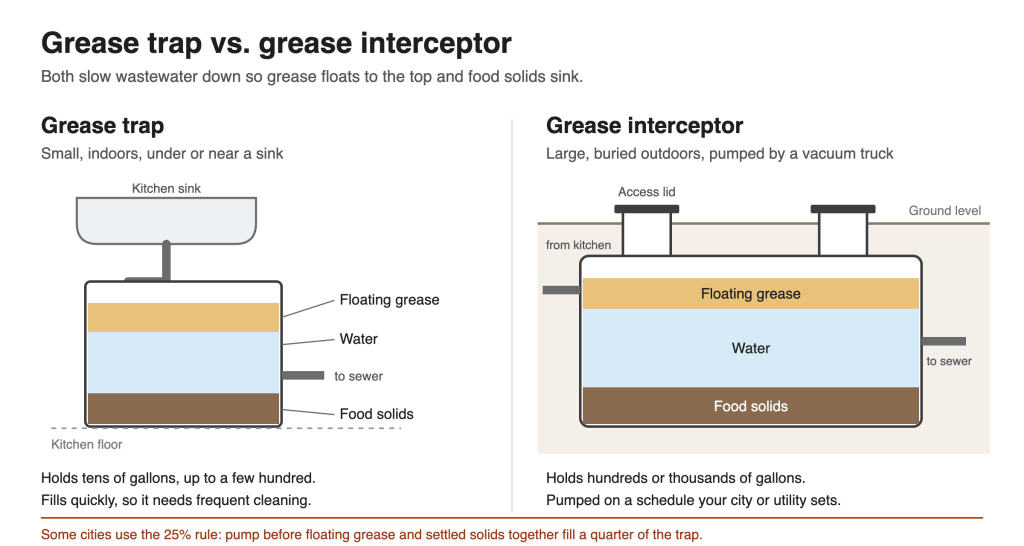
Short answer: a grease trap is usually a small unit installed indoors at the sink and rated by flow in gallons per minute. A grease interceptor is usually a large tank buried outside and sized by how many gallons it holds. Both separate grease from wastewater. Your local code decides which one you need.
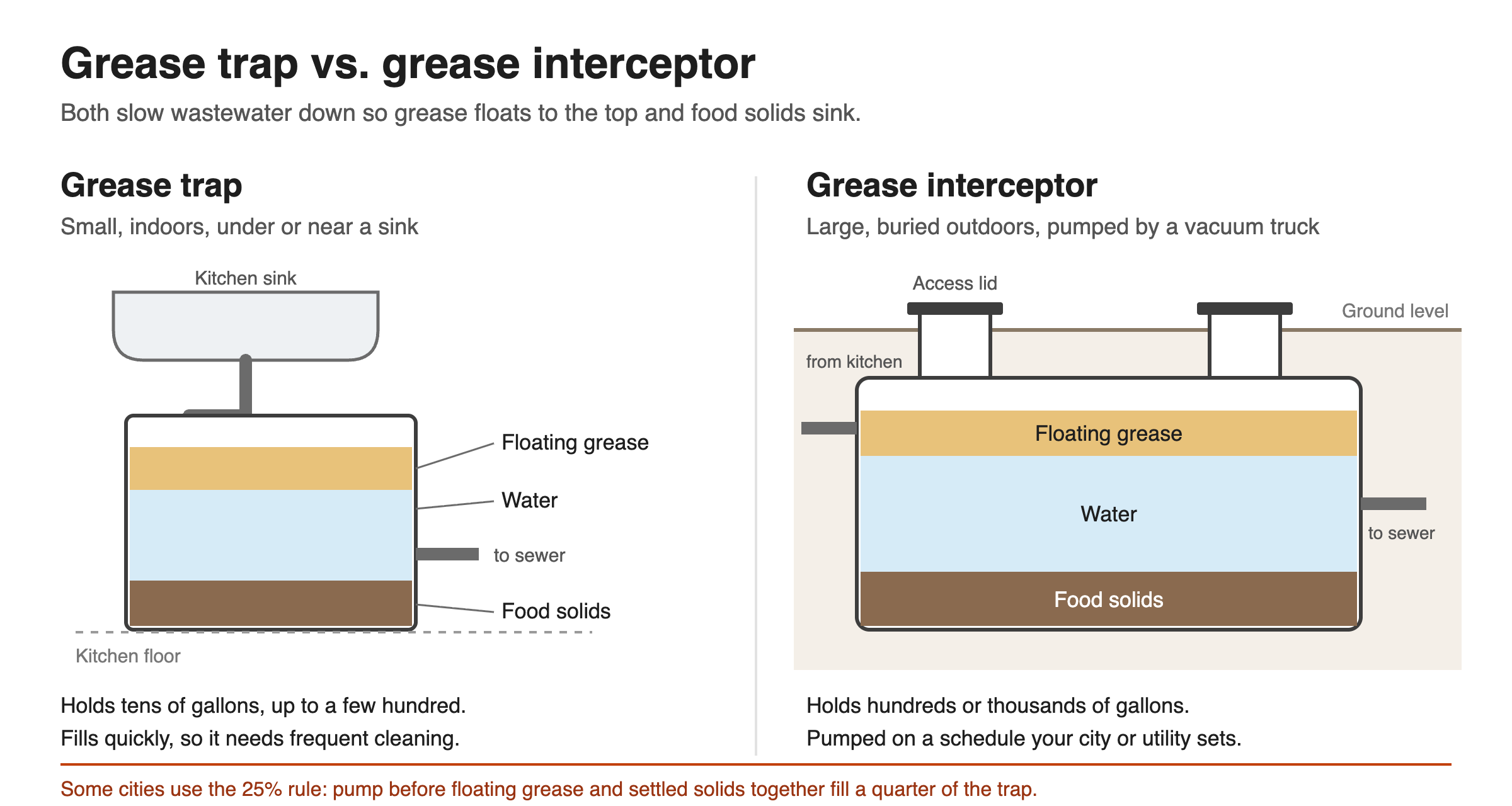
Grease trap vs. grease interceptor at a glance
| Feature | Grease trap (hydromechanical) | Grease interceptor (gravity) |
|---|---|---|
| Where it sits | Indoors, at or near the sink | Outdoors, underground |
| How it works | Baffles and air entrapment separate grease as water flows through | A large volume of water slows flow so grease floats and solids sink |
| Rated or sized by | Flow, in gallons per minute (common sizes 10 to 100 gpm) | Volume, in gallons (common sizes 300 to 3,000 gallons) |
| Product standard | PDI G101 and ASME A112.14.3 | Sized by code formulas for flow and retention time |
| Who empties it | Often cleaned on a short cycle; some cities allow staff cleaning | Pumped by a vacuum truck |
Why the two terms get confused
In plumbing codes, both are technically grease interceptors. In 2006 the industry adopted the names hydromechanical grease interceptor for the small flow-rated unit and gravity grease interceptor for the large tank, according to Plumbing & Mechanical. Kitchen staff and many city programs still call the small one a “grease trap”, and some, like Lexington’s, say “indoor” and “outdoor” grease traps.
How each one is sized
- Grease trap: by the flow it can handle. A unit is tested at its rated flow in gallons per minute, which is also its size.
- Grease interceptor: by the water it holds. One common method multiplies expected flow by a retention time; at 20 gpm and 30 minutes, that’s 600 gallons.
Codes differ on the details. Plumbing & Mechanical describes a 300-gallon minimum for gravity interceptors, while Scottsdale, Arizona, under its amended 2021 International Plumbing Code, requires at least 500 gallons. Sizing is a job for a plumber or engineer working to your local code.
Which one does your kitchen need?
Your local building code and sewer authority decide. Common deciding factors are how many sinks and fixtures drain grease, whether you run a dishwasher, and how much space you have. As one example, Scottsdale allows a small indoor unit only for four or fewer food-preparation fixtures, and requires a gravity interceptor for any kitchen installing a dishwasher.
How six cities regulate traps and interceptors
| City | What the rules cover | Pumping or cleaning rule |
|---|---|---|
| Knoxville, TN | Grease traps (KUB standards) | At least monthly unless KUB approves otherwise |
| Chattanooga, TN | Both, with separate rules | Traps weekly; interceptors every 3 months or at 25% |
| Lubbock, TX | Grease interceptors | At least every 90 days |
| Corpus Christi, TX | Both, same rule | Every 90 days or at 25% of depth |
| Amarillo, TX | Grease traps | Regular maintenance; 10 business days if flagged |
| Lexington, KY | Indoor and outdoor grease traps | Indoor weekly; outdoor every 6 months |
For the full schedules and the 25% rule, see how often a grease trap should be cleaned. For prices by size, see our grease trap cleaning cost guide.
Frequently asked questions
Is a grease trap the same as a grease interceptor?
They do the same job, and codes call both interceptors. In everyday use, “grease trap” means the small indoor unit and “grease interceptor” means the large outdoor tank.
Can I swap an interceptor for a smaller trap?
Only if your local code and sewer authority allow it. Many codes set minimum sizes and require larger units for kitchens with dishwashers or many fixtures. Ask your city’s grease program before changing equipment.
Not sure which one you have?
A local grease trap service provider can tell you on the first visit. Tell us about your kitchen and one will contact you within 1 business day. It’s free, with no obligation to hire.
Sources
- Rand Ackroyd, Sizing Grease Interceptors, Plumbing & Mechanical (May 2008)
- City of Scottsdale, Grease Interceptor Guidelines (amended 2021 IPC, last modified January 2023)
- City rules: see each city page for its official source
By the Grease Trap Guide team. How we make our guides. This summary isn’t legal or engineering advice; confirm requirements with your local authority. Last reviewed October 2026.

