
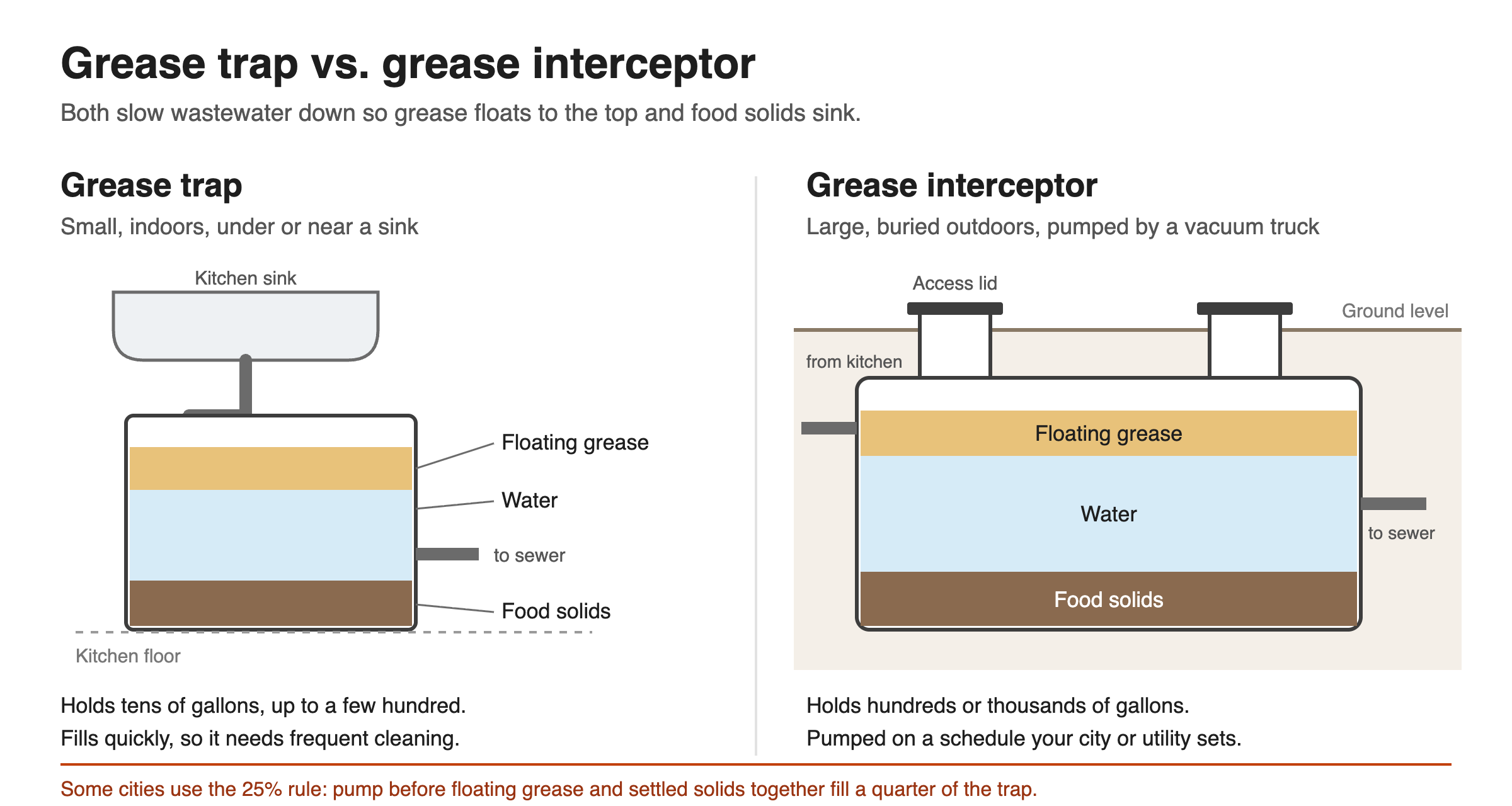
Short answer: a grease trap is a box or tank on a kitchen’s drain line that catches fats, oils and grease before they reach the sewer. Wastewater slows down inside it, grease floats to the top, food solids sink, and the cleaner water in the middle flows out. It must be pumped regularly.
How does a grease trap work?
The EPA says these devices must be sized “to allow FOG to cool and separate in a non-turbulent environment.” The City of Bellevue, Washington, describes the process step by step:
- Wastewater flows in from the kitchen sinks and fixtures, limited to the trap’s rated flow.
- Grease floats. Oil and grease rise to the surface and collect behind baffles, walls inside the trap that hold it back.
- Solids sink. Food particles that don’t float settle on the bottom.
- Water leaves. The water between the two layers flows out to the sewer.
- Someone empties it. The trapped grease and solids stay inside until kitchen staff or a hauler cleans or pumps the trap, depending on its size and local rules.
Larger outdoor units, called grease interceptors, work the same way on a bigger scale. In Bellevue’s description, fittings inside the tank reach down to within 12 inches of the bottom, so only water from below the grease layer can leave.
Grease trap or grease interceptor?
People often use the two names for the same thing. In general, a grease trap is a small unit indoors, under or near a sink, and a grease interceptor is a large tank, usually buried outside and emptied by a vacuum truck. Your city’s code may define them differently. See grease trap vs. grease interceptor for the full comparison.
Why do grease traps matter?
Grease poured down a drain cools and hardens in the pipes. The EPA reports that grease from restaurants, homes and industry is the most common cause of reported sewer blockages, at 47%, and explains that grease “solidifies, reduces conveyance capacity, and blocks flow.” Blockages can cause sewer backups and overflows.
Who needs a grease trap?
Rules are local, but many cities with a fats, oils and grease (FOG) program require one at restaurants and other food service establishments. Bloomington, Indiana, for example, requires every new and remodeling food service establishment to install a grease interceptor. Check the rules for your city:
- Amarillo, TX, Austin, TX, Corpus Christi, TX, Lubbock, TX
- Chattanooga, TN, Knoxville, TN
- Lexington, KY
How do you keep a grease trap working?
- Pump it on schedule. Cities set a minimum interval, often every 90 days for interceptors, and many also require pumping once grease and solids fill a set share of the trap. See how often grease traps must be cleaned.
- Don’t use products that push grease through. Austin’s code, for example, bans enzymes, bacteria or other agents that would make trap contents pass into the sewer.
- Keep food out of drains. Scrape plates into the trash and use sink strainers.
- Check local rules on garbage disposals. Some cities, such as Bloomington, ban new garbage disposals in food service establishments.
- Keep every pump-out record. Inspectors ask for them; see what to expect at a grease trap inspection.
Skipping maintenance can be expensive. Austin Water, for example, warns of penalties of up to $2,000 per violation per day. For typical prices, see grease trap cleaning cost and grease trap installation cost.
Need your grease trap serviced?
Tell us your city and trap type. We pass your request to a local grease trap service provider. It’s free, with no obligation to hire.
Sources
- U.S. EPA, Controlling Fats, Oils, and Grease Discharges from Food Service Establishments (EPA-833-F-12-003, September 2012), citing EPA’s 2004 report to Congress on sewer overflows
- City of Bellevue, WA, Fats, Oils & Grease: How the System Works
- City of Bloomington Utilities, Grease Interceptor Information
- Austin Water, Grease Trap Maintenance
By the Grease Trap Guide team. How we make our guides. This is general information, not legal advice; confirm requirements with your local utility. Last reviewed November 2026.

