
Restaurants and other food service businesses in San Antonio follow the grease rules in City Code Chapter 34, enforced by the San Antonio Water System (SAWS). This guide explains them in plain language, including the yearly interceptor inspection, what grease trap service typically costs, and how to stay compliant.
San Antonio rules at a glance
- How often: at least every 90 days, and within 2 working days once grease and solids reach 25% of the wetted height
- Who can pump: a SAWS-permitted hauler for interceptors over 100 gallons
- Yearly inspection: by a licensed plumber or SAWS-approved professional, with photos
- Records: kept on site for 5 years
Free grease trap service quotes in San Antonio
- Tell us about your trap or interceptor in about 2 minutes.
- We pass your request to a local service provider, who contacts you directly.
- Free, with no obligation to hire.
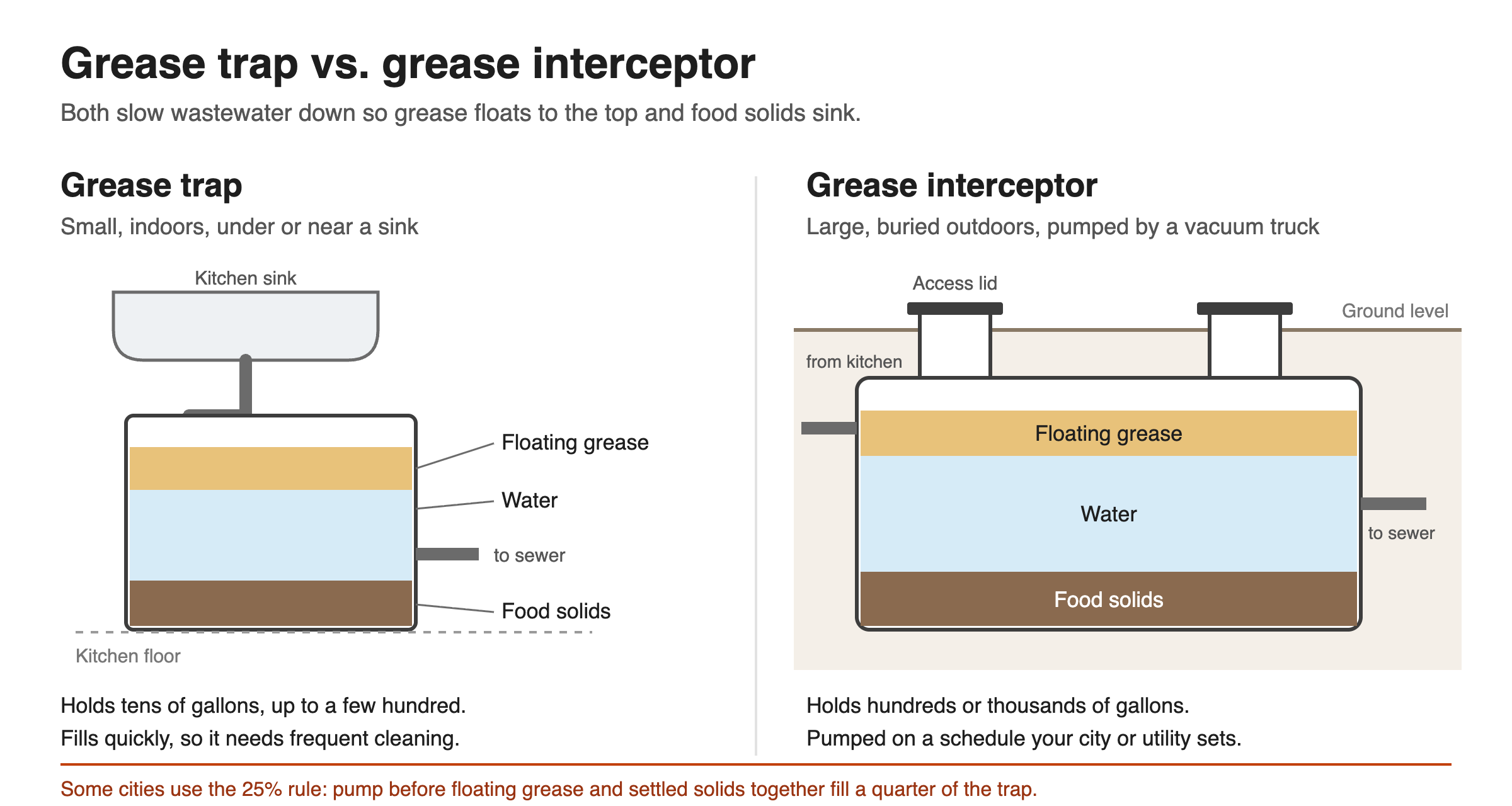
How often must grease interceptors be pumped in San Antonio?
- At least every 90 days (City Code § 34-527(b)).
- Within 2 working days under the 25% rule: once fats, oils, grease and solids reach 25% or more of the interceptor’s wetted height, it must be pumped within two working days, even if 90 days haven’t passed.
- No grease-dissolving products: the code bans putting solvents, emulsifiers, enzymes, chemicals, or bacteria that digest or dissolve grease into an interceptor (§ 34-529(a)).
The yearly interceptor inspection
San Antonio requires a yearly inspection. At least once per calendar year, each interceptor must be inspected by a licensed plumber or another professional approved by SAWS (§ 34-527(d)). The inspection happens after the interceptor is emptied: the inspector examines it and photographs the inlet and outlet fittings, baffles, walls and floor, then gives you a written report.
- Due date: SAWS’s inspection checklist (revised March 2016) says inspection and certification are due each year no later than December 1.
- Repairs: any defects must be fixed within 90 days of the inspection.
- Who to use: SAWS publishes a list of certified interceptor inspectors on its annual inspection page.
Tip: schedule the inspection right after a pump-out, so the interceptor is already empty. For what inspectors generally look at, see what to expect at a grease trap inspection.
Who can pump your interceptor?
For interceptors over 100 gallons, the code requires a liquid waste hauler permitted by SAWS. For units of 100 gallons or less, it says businesses “may” use a SAWS-permitted hauler. Either way, the waste must go to a facility permitted to receive it (§ 34-527(c)). Haulers also have state duties; see our guide to Texas grease trap rules.
What records do you need to keep?
The code requires records to be kept for five years and available for inspection on your premises (§ 34-528(c)). SAWS can approve keeping them somewhere else, such as a central office, if you ask in writing. Keep your hauler manifests and each yearly inspection report, with its photos, together.
What happens if you don’t comply?
Under § 34-531, a violation can be charged as a class C misdemeanor with a fine of $200 to $2,000 per violation, or as a civil penalty of up to $5,000 per violation, and each day a violation continues counts separately. SAWS may also cut off water or sewer service if a violation isn’t fixed within 90 days of notice.
How much does grease trap service cost in San Antonio?
Price depends on the size of your interceptor, how often it’s serviced, how easy it is to reach, and travel distance. As a general guide, published industry price guides list roughly $130 to $200 per cleaning for small indoor traps under a service agreement ($200 to $250 for a one-off visit), and roughly $240 to $330 per pumping for a 1,000 to 1,500 gallon outdoor interceptor on contract. Budget separately for the yearly inspection. Local San Antonio prices may differ, so request a quote for an exact figure. See our grease trap cleaning cost guide for typical prices, extra fees and yearly costs.
Want to see how San Antonio’s rules compare with other cities? Read our guide: How often should a grease trap be cleaned?
Signs your interceptor needs service sooner
- Sinks or floor drains are draining slowly.
- You notice grease or sewer odors near drains or the interceptor lids.
- Water or grease is backing up into sinks or onto the floor.
- Your hauler measures grease and solids close to a quarter of the wetted height.
What if your grease trap is backing up?
- Stop sending water and grease down the affected drains until the trap is pumped.
- Call your regular hauler first and ask whether they offer emergency or after-hours pumping. Expect to pay more: one city price list adds $75 to $225 for service within 24 hours (see our cleaning cost guide).
- If wastewater spills outside or toward a storm drain, contact your local wastewater utility.
- Keep the manifest from an emergency pump-out with your other service records.
You can also use our quote form, but we can’t promise same-day service.
Tips to stay compliant
- Book recurring pumping at least every 90 days, and sooner if your hauler measures close to 25%.
- Put the yearly inspection on your calendar well before December 1, timed right after a pump-out.
- Use a SAWS-permitted hauler and keep every record for five years.
- Scrape plates into the trash and use sink strainers to keep food out of drains.
- Never pour fryer oil or grease down a drain, and don’t use grease-dissolving products in the interceptor.
Frequently asked questions
Does my interceptor really need an inspection every year?
Yes. San Antonio’s code requires an inspection by a licensed plumber or SAWS-approved professional at least once per calendar year, and SAWS’s checklist sets December 1 as the due date.
Can I use enzymes or bacteria to treat my interceptor?
No. The code bans enzymes, emulsifiers, chemicals, and bacteria that digest or dissolve grease in an interceptor.
How do I get a quote?
Fill in our quote request form with your location, trap type, and last service date. We pass your request to a local service provider, who contacts you directly. Using this site is free.
Get grease trap service in San Antonio
Tell us about your kitchen and we’ll pass your request to a local grease trap service provider. It’s free, and you’re under no obligation to hire anyone.
Sources: City of San Antonio Ordinance 2011-05-12-0378 (FOG ordinance, City Code Chapter 34); SAWS, Annual Inspection; SAWS Grease Interceptor Annual Inspection & Certification Checklist (rev. March 2016). The ordinance text is from 2011; SAWS’s current inspection page quotes the same rule. Cost ranges are general industry estimates, not San Antonio quotes. This summary isn’t legal advice; confirm current requirements with SAWS (210-233-3542). Last reviewed November 2026.

